TSMC’s N5A enhances N5 for the rigors of the modern vehicle and was qualified for automotive applications in 2022. N5A delivers an approximate 20% improvement in speed, or an approximate 40% improvement in power efficiency, and a nearly 80% improvement in logic density, compared to TSMC’s N7A technology.
Automotive quality and reliability standards are far more rigorous than those for consumer products. TSMC’s automotive commitment is reflected in its “Zero Defect” mindset. TSMC has diligently applied the lessons learned by manufacturing over billions of chips and applied them to its automotive technologies. The result is world-class D0 and defective parts per million (DPPM) for superior reliability and overall quality. TSMC’s technology leadership and scale provided the world’s most advanced automotive semiconductor technology a few short quarters after it became available for consumer products.
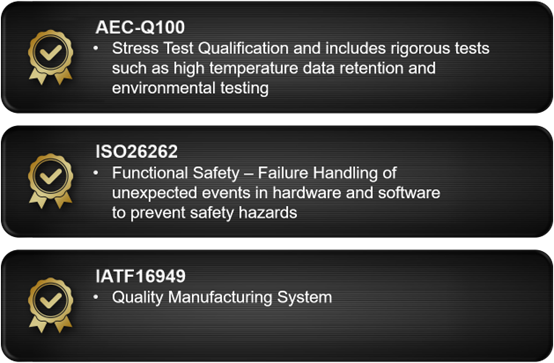
TSMC’s 16FFC, N7A, and N5A technologies have passed the automotive standards for quality, reliability, and functional safety, according to AEC-Q100, ISO 26262, and IATF 16949 standards.
TSMC ensures that its design ecosystem partners are using automotive verified foundation IP and building blocks by also extending TSMC IP9000A assessment requirements.
Automotive Industry Standards for TSMC N5A
All diagrams, animations, and videos are for demonstrative and illustrative purposes only
Automotive IP Ecosystem
The four elements of TSMC’s Automotive Ecosystem are: technology, foundation IP, third-party IP, and manufacturing. TSMC provides all the critical deliverables necessary for differentiated automotive solutions.

TSMC’s advanced technologies are developed on its Automotive IP ecosystem platform. Innovated FinFET technology enables superior performance and provides robust reliability and low parts per million (PPM) advantage. The Company’s expanded derivative technology portfolio includes millimeter wave (mmWave) RF for radar applications, magnetoresistive random-access memory (MRAM), and non-volatile memory (NVM).
